
Yes, it can. Catalytic converter value in a junk car runs from about $10-$30 for an aftermarket unit to $75-$700 or more for an original-equipment converter, and up to $1,400 for some hybrids. The steel in a light sedan is worth roughly $200-$400. Cash Car Heroes prices the converter into every Indianapolis offer, so leave it bolted on.
Last updated: August 2026
On the night of May 21, 2026, somebody crawled under the school buses at Beech Grove City Schools and cut the catalytic converters off 20 of them. The next morning the district could not run routes, only about two-thirds of kids made it to class, and the superintendent called the repair bill “incredibly expensive” (WISH-TV, 2026). That happened about ten minutes from our yard. We pick up junk cars in Beech Grove every week.
Thieves understand something most car owners never think about: on an old vehicle, the single most valuable thing is often a rusty can under the floorboard. If your car is worth $400 as scrap, the converter inside it can be worth more than that on its own.
We buy junk cars for a living, so we have a stake in how you handle yours. That is why the numbers below come from the U.S. Geological Survey, Carfax, Johnson Matthey, the Indiana Secretary of State, and live metal markets — not from us. Read the math, then decide.
Why Is a Catalytic Converter Worth So Much Money?
Because it is a small box lined with three of the most expensive metals on earth: platinum, palladium, and rhodium. Hot exhaust passes over a ceramic honeycomb coated in those metals, and they trigger the chemical reactions that turn carbon monoxide and nitrogen oxides into less harmful gases. How much metal? Estimates vary a lot, and it is worth seeing the spread. Universal Technical Institute puts a standard converter at 3 to 7 grams of platinum, 2 to 7 grams of palladium, and 1 to 2 grams of rhodium (Universal Technical Institute, 2021). The U.S. Geological Survey is more conservative for small vehicles and more generous for big ones: 2 to 6 grams of platinum-group metal total for cars and light trucks, and 6 to 30 grams for SUVs and full-size trucks (USGS, 2013). Engine size is the reason for the gap.
A few grams does not sound like much until you look at the price per ounce. At the end of August 2026, rhodium traded around $9,000 per troy ounce, up 9% in a month and nearly 28% over the past year (Trading Economics, 2026). Platinum sat near $1,800 and palladium near $1,400 (Kitco, platinum and palladium, 2026). Platinum hit an all-time high in January 2026, and Johnson Matthey reports that strong prices are pulling rhodium recoveries from automotive scrap to a four-year high (Johnson Matthey, 2026).
| Metal | Typical grams per converter | Price per troy ounce, late August 2026 | Contained value (our math) |
|---|---|---|---|
| Rhodium | 1–2 g | About $9,000 | $290–$580 |
| Platinum | 3–7 g | About $1,800 | $175–$405 |
| Palladium | 2–7 g | About $1,400 | $90–$315 |
| Total | 6–16 g | — | Roughly $550–$1,300 |
Gram figures are the Universal Technical Institute (2021) estimate, which sits at the high end — USGS puts a car or light truck at 2 to 6 grams of platinum-group metal total, so read this table as a well-loaded converter rather than an average one. Prices from Trading Economics and Kitco on August 31, 2026; one troy ounce is 31.1 grams. Nobody pays full contained value — the metals have to be assayed, crushed out of the ceramic, and refined — but this is why a scrap converter fetches hundreds of dollars instead of the $5 its steel shell is worth.
David Glawe, President and CEO of the National Insurance Crime Bureau, summed up the whole market in one line: “It’s an opportunistic crime. As the value of the precious metals contained within the catalytic converters continues to increase, so do the number of thefts of these devices” (NICB, 2021). Converters were the leading domestic use of platinum-group metals again in 2025 (USGS, 2026). Every one that gets recycled feeds the next one that gets built.
How Much Is a Catalytic Converter Worth for Scrap in 2026?
Anywhere from about $10 to over $1,000, and the spread comes down to one question: is it the original factory unit or an aftermarket replacement?
| Converter type | Typical 2026 scrap value | Why |
|---|---|---|
| Aftermarket replacement | $10–$30 | Built to the legal minimum; thin metal loading |
| Standard domestic OEM (sedans) | $90–$275 | Factory loading on a 4- or 6-cylinder |
| Foreign OEM (Toyota, Honda, Nissan) | $110–$320 | Import automakers historically loaded heavier |
| Full-size truck / SUV OEM | $200–$550 | Bigger engine, more metal, often two units |
| European / exotic | $300–$800 | High-output engines, tight emissions targets |
| Hybrid (Prius-type) | $400–$1,100 | Runs cooler, so it needs more metal to work |
Ranges from RecycleFind (August 2026) and JunkyardInventory (May 2026); ScrapMonster’s August 25, 2026 price board shows the same shape, from $17 for aftermarket units to $677 for its top grade. Prices move weekly with the metals.
The aftermarket line matters more than people expect. If your car ever had its converter replaced at a muffler shop, odds are it got an aftermarket unit, and that unit is worth about as much as a tank of gas. Here is how to tell: a factory converter has the automaker’s part number stamped into the shell, while an aftermarket unit carries the replacement brand’s name and the EPA-required compliance label instead — a code in the format N/XX/YYYY/ZZZZ (EPA aftermarket converter policy). Aftermarket shells also tend to be visibly thinner and lighter.
One more thing the charts skip: 2026 prices are still well below the 2021-2022 peak. Rhodium averaged $20,254 an ounce in 2021 and $4,660 in 2024 before climbing to an estimated $5,800 in 2025; palladium fell from $2,419 to $995 over the same stretch (USGS, 2026). So the “$1,500 Prius cat” your neighbor bragged about back then is a $300-$700 cat today. Still real money. Just not that money.
Which Vehicles Have the Most Valuable Catalytic Converters?
Hybrids, full-size trucks, and heavy-duty pickups. Here is a per-vehicle snapshot:
| Vehicle | 2026 scrap value | 2022 peak |
|---|---|---|
| Toyota Prius (2004–2015) | $300–$700 | $800–$1,500 |
| Ford F-250 diesel | $250–$450 | $500–$900 |
| Ram 2500 | $200–$400 | $400–$800 |
| BMW 3 Series | $150–$300 | $300–$600 |
| Ford F-150 V8 | $150–$250 each (two per truck) | $300–$500 each |
| Chevy Silverado V8 | $125–$225 each | $250–$400 each |
| Toyota Tacoma | $100–$200 | $200–$400 |
| Honda Accord 4-cylinder | $75–$150 | $150–$300 |
Source: JunkyardInventory, May 2026. Treat these as market ranges, not offers. Diesel is the line the boards disagree on most: JunkyardInventory quotes $250-$450 for an F-250 unit, while RecycleFind grades diesel converters at $20-$120 and ScrapMonster lists a plain “diesel” cat at $13. Year, emissions system, and serial number decide it.
Why the Prius? Hybrid converters carry a heavier dose of precious metal. Recyclers were paying $800 to $1,500 for hybrid units back when a standard converter fetched $50 to $250 (Universal Technical Institute, 2021). According to Patrick Olsen, Editor-in-Chief at Carfax, “while thieves can make anywhere from $25-$300 for a standard catalytic converter, converters from hybrid vehicles can sell for up to $1,400 because they have even more of those precious metals inside” (Carfax, 2026).
Thieves read the same list. Carfax’s June 2026 ranking of the most-targeted vehicles is a truck-and-SUV parade: Ford F-150, Hyundai Tucson, Ford Explorer, Ram 2500, Chevy Silverado, Chevy Traverse, Ram 3500, Ford EcoSport, Ford Expedition, Chevy Trax (Carfax, 2026). Olsen’s explanation: “most of these are pickup trucks and SUVs, which tend to sit higher off the ground, making it easier for thieves to get in and out.” The cars we see come in cut around Indy skew a little different — Honda Accords, CR-Vs, and Priuses show up often enough that we ask about the converter before we quote them.
Can a Catalytic Converter Really Be Worth More Than the Car?
Yes, and it happens more often than you would guess. Run the numbers on a typical Indianapolis junk car.
Shredder-grade steel from vehicle recycling paid $0.07 to $0.14 per pound nationally on August 31, 2026, and it had slipped 4.4% in the prior 30 days (Scrap Monitor, 2026). A compact car or hybrid weighing around 3,000 pounds is therefore worth about $200 to $400 in raw metal. Now put a 2008 Prius with a blown hybrid battery on that scale: the shell is worth $200-$400, and the single original converter is worth $300-$700. The converter can win outright.
Same story with a rotted-out 2003 F-250 diesel: frame gone, engine tired, but a $250-$450 converter still hanging underneath. Or a 2005 Accord with a dead transmission, where a $75-$150 factory converter is roughly a quarter of the whole car’s scrap value.
This is the gap between a scrap-weight buyer and a parts-aware buyer that we covered in how much junkyards pay for cars. A yard that only weighs your car pays for steel. A buyer that dismantles cars can pay for the converter, the engine, the aluminum wheels, and the steel. It is also why the $500, $1,000, and $1,500 junk car tiers swing so hard on whether the converter is still there.
Here is the part that trips people up: “the converter is worth more than the car” does not mean you should split them. Cut the converter off, and you do not get converter money plus car money. You get a fraction of the converter money, a car that just fell to scrap weight, and in Indiana, a legal problem. Keep reading.
Want to know what your car is worth with the converter counted in? Cash Car Heroes quotes in 10–15 minutes during business hours, 7 days a week, 8am–8pm. Free towing, cash or check on the spot, and 4.8 stars across 1,219+ Google reviews. Get your free quote →
Should You Remove the Catalytic Converter Before Selling a Junk Car?
No. Not in Indiana, and honestly not anywhere. Three reasons.
1. You probably cannot sell it legally. Since Senate Enrolled Act 293 took effect on July 1, 2022, a detached catalytic converter is treated as a major component part, and only a licensed salvage recycler may buy or sell one (Indiana Secretary of State, 2022). Unless you are a used-parts dealer or an auto repair shop, the only acceptable proof that a loose converter is yours is an affidavit signed by a law enforcement officer. The buyer has to record your name, address, ID, license plate, and a photo of you and the part, and may hand you no more than $25 in cash — anything above that comes by check (Indiana Secretary of State, 2022). Stealing one is a Level 6 felony (Indiana Courts, 2021), and a private seller showing up with a sawed-off converter and no paperwork looks exactly like the person that law was written for.
2. The math goes backward. A thief nets $25-$300 for a standard converter (Carfax, 2026), and a legitimate seller without dealer status will not do better through legal channels. Meanwhile the car it came off of just became a stripped vehicle, and stripped vehicles price at scrap weight. In our experience, pulling the converter costs the seller more on the car than it ever earns on the part — routinely a full price tier. The pre-sale checklist says the same thing about batteries, wheels, and stereos: leave the valuable parts on.
3. You will damage the car doing it. A converter comes out with a reciprocating saw through the exhaust, usually taking oxygen sensors and sometimes brake or fuel lines with it. Now the car is missing its converter and has fresh cut damage, and both show up in the inspection at pickup.
Here is what to do instead:
- Leave the converter exactly where it is. Bolted to the car, it is legal to sell, easy to verify, and worth the most.
- Tell the buyer whether it is original. If a muffler shop replaced it years ago, say so. An accurate description keeps the quote and the pickup price the same number.
- Do not let the car sit. A dead car in a driveway with a valuable converter is a target. Rhodium is up nearly 28% over the past year, and theft follows the metal.
- Sell the whole car to a buyer that prices parts. That is how you actually collect the converter’s value.
What If Your Catalytic Converter Was Already Stolen?
Sell the car anyway. Do not replace the converter first.
Replacing a stolen converter is a $2,000-$3,000 job: State Farm’s average theft claim reached about $2,900 in 2024, up from $1,900 in 2019 (State Farm, 2024), and Carfax puts the bill at up to $3,000 (Carfax, 2026). Spending that to add a few hundred dollars to a junk car offer is lighting money on fire. The car still has its engine, transmission, wheels, and steel, and buyers like us purchase converter-less cars every week. It sells for less than it would have, but it sells.
Three practical steps:
- File a police report with IMPD or your local department. You will want it for insurance, and it documents that the converter is missing because of theft, not because you sold it.
- Say it up front when you request a quote. "Catalytic converter was stolen" is the single most useful sentence you can give a junk car buyer. It keeps the offer honest from the first call, so the driver is not discovering it in your driveway.
- Do not drive it far. A car with no converter is loud, illegal to operate on the road, and may throw a check-engine light. Free towing exists for a reason.
And do not assume theft is yesterday’s problem. Insurance claims collapsed after the 2022 peak — State Farm alone went from 45,000 converter theft claims in 2022 to about 7,600 in 2024 (MoneyGeek, 2026) — but Carfax’s shop data shows more than 137,000 converters stolen in 2025 as metal prices climbed back (Carfax, 2026). Economists at the London School of Economics found that a 10% rise in converter value produces a 4.5% to 8.9% rise in auto-parts theft (LSE, 2026). Rhodium is up nearly 28% over the past year. Draw the line yourself. If you are sitting on a car that does not run, its converter is worth more to a thief every month it waits.
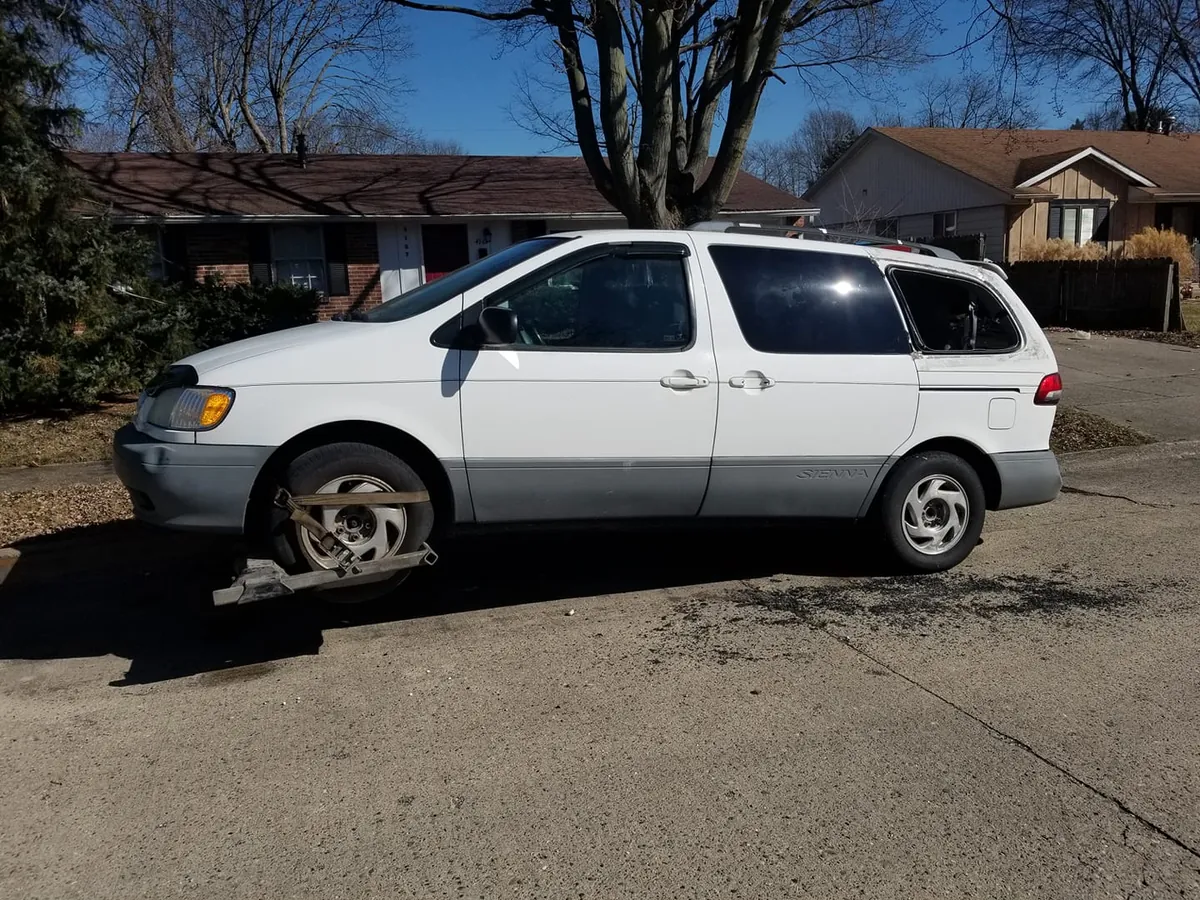
How Does Cash Car Heroes Price the Converter Into Your Offer?
We do not write you a separate check for the converter. We fold it into one number, the same way we price everything else on the car.
Every Cash Car Heroes offer is built from four things: the year, make, and model; the vehicle’s size and weight; its condition; and the demand for its parts. The converter lives inside “condition.” An intact factory converter on a Prius, a Tacoma, or a Silverado pushes the offer up because we know exactly what that part is worth this week. A missing or aftermarket unit pulls it down. Our full guide to junk car value in Indianapolis walks through all four factors.
We can do this because of what we are. Cash Car Heroes is the buying arm of a locally family-owned, fully licensed, bonded, and insured auto salvage recycler on the south side of Indianapolis, and a salvage recycler license is precisely what Indiana requires to handle catalytic converters at all. When your car reaches our yard, the converter is pulled and sent for precious-metal recovery, the usable parts get a second life at our sister yard, The New Country Auto Parts, backed by a 30-day warranty, and the steel is recycled. That vertical setup is why we can bid above scrap weight, and it is what happens to your junk car after you sell it.
Two honest limitations. We do not publish a price list, so we cannot tell you over the phone what your converter alone is worth — only what the whole car is worth with it. And if the car’s condition at pickup does not match what we were told (a converter described as original that turns out to be cut off, say), the offer gets adjusted. Describe the car accurately and there is nothing left to find at pickup, which is how almost every one of ours goes. If another buyer offers to pay you cash for a loose converter with no paperwork, that is one of the junk car scams worth walking away from.
Our take, for whatever it is worth: a catalytic converter is worth the most exactly where it sits. Bolted to the car. Sold together. Priced by someone who knows what it is.
Converter on or converter gone, we buy it. Cash Car Heroes pays cash on the spot for junk cars across Indianapolis, Greenwood, Beech Grove, Carmel, Fishers, and all of Central Indiana. Free towing, same-day pickup for 86% of accepted offers. Call or text (317) 538-4824 or see how our cash for junk cars service works →
Frequently Asked Questions
How much is a catalytic converter worth for scrap in 2026?
Roughly $10-$30 for an aftermarket replacement, $90-$275 for a standard domestic factory unit, $200-$550 for full-size truck and SUV converters, and $400-$1,100 for hybrids, per 2026 scrap price boards. Rhodium, platinum, and palladium prices drive the number, and they change weekly. The converter is worth the most when it is sold still attached to the car.
Which cars have the most valuable catalytic converters?
Toyota Prius and other hybrids lead, at roughly $300-$700 per converter in 2026 and up to $1,400 in some cases (Carfax, 2026). Diesel pickups such as the Ford F-250 and Ram 2500 run $200-$450 (JunkyardInventory, 2026), though scrap boards disagree widely on diesel units. Full-size gas trucks like the F-150 and Silverado carry two converters worth $125-$250 each. Small four-cylinder sedans sit at the bottom, around $75-$150.
Is it illegal to sell a catalytic converter in Indiana?
For most people, effectively yes. Under Indiana law, a detached converter may only be bought or sold by a licensed salvage recycler, and a private seller needs a law-enforcement affidavit to prove ownership. Cash payment is capped at $25 per transaction, with the rest by check (Indiana Secretary of State, 2022). Selling the whole car with the converter attached avoids all of it.
Should I cut off the catalytic converter before selling my junk car?
No. You would net at most $25-$300 for a standard converter, you would need a police affidavit to sell it legally in Indiana, and the car you cut it from would drop to scrap-weight value — often a full price tier. A parts-aware buyer like Cash Car Heroes prices the intact converter into the offer, which pays more with none of the risk.
How much less is a junk car worth without a catalytic converter?
Enough to notice. The converter is the most valuable removable part on most junk cars, so a missing one can knock a car from a parts-value offer down toward scrap weight, which for a 3,000-pound car is about $200-$400 at August 2026 shredder prices. The car still sells — it just sells for its steel, engine, and wheels rather than its precious metals.
Can I sell a junk car if the catalytic converter was stolen?
Yes. File a police report, tell the buyer up front that the converter was stolen, and get a quote for the car as it sits. Do not replace it first: the average theft repair claim runs about $2,900 (State Farm, 2024), far more than a converter adds to a junk car offer. Cash Car Heroes buys converter-less cars regularly and tows them for free.
How do I know if my catalytic converter is OEM or aftermarket?
Look at the shell. A factory (OEM) converter has the automaker’s part number stamped into the metal and a heavier, thicker housing. An aftermarket replacement carries the replacement brand’s name and the EPA-required compliance label, and it is usually thinner and lighter (EPA aftermarket converter policy). If a muffler shop replaced your converter after 2000, assume it is aftermarket and worth $10-$30.
Get Your Cash Offer Now!
Free • No Obligation • Takes 60 Seconds